Digital Transformation
Digital transformation is often described in terms of technology: new platforms, cloud services, automation, analytics, artificial intelligence, digital channels, and modern infrastructure.
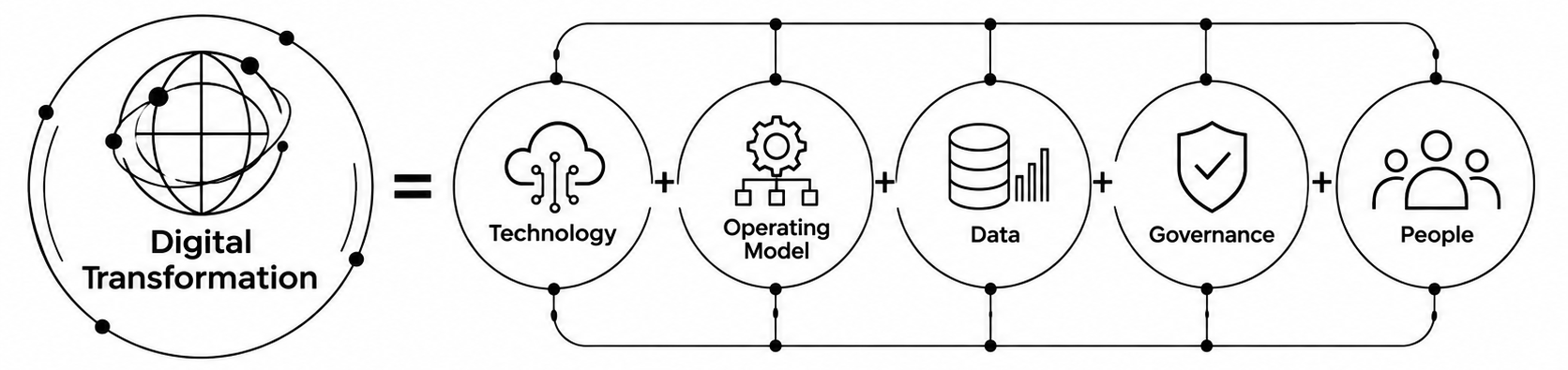
Technology matters, but it is only part of the picture. Digital transformation is fundamentally about changing how an organization operates, makes decisions, manages information, delivers services, and adapts to its environment. It affects processes, responsibilities, governance, data, people, and technology together.
That is why successful transformation is rarely just an IT project.
More Than Technology Implementation
A system implementation usually has a defined technical objective: deploy a platform, integrate applications, migrate infrastructure, automate a process, or introduce a new digital service.
Digital transformation goes further.
It may require an organization to reconsider how work is structured, how decisions are made, how information flows between functions, which activities should be automated, where human control remains essential, and how technology supports the operating model as a whole.
An organization can invest heavily in modern technology and still retain inefficient processes, fragmented responsibilities, inconsistent data, and outdated decision-making practices. In that case, digitalization may simply make existing problems faster.
Effective transformation starts with a deeper question:
What actually needs to change?
Sector Context Matters
There is no universal model of digital transformation.
A bank, public institution, healthcare organization, utility, industrial company, or growing business may use similar technologies, but the transformation priorities, risks, regulatory requirements, and operating realities are very different.
The same technology can therefore be appropriate in one environment and unsuitable in another.
Meaningful transformation requires both digital competence and sector understanding. It requires awareness of regulation, operational risk, organizational structure, data sensitivity, decision rights, and the practical constraints of implementation.
The objective is not to adopt technology because it is available. It is to understand where it creates sustainable value and how it changes the organization around it.
Data, Context and Better Decisions
Modern digital transformation is increasingly data-driven.
Analytics, machine learning, generative AI, and agentic systems depend not only on data quality, but also on context. Data can be technically valid and still be misunderstood, interpreted inconsistently, or combined incorrectly.
This makes data governance, common definitions, taxonomies, ontologies, ownership, traceability, and semantic consistency increasingly important.
As more decisions become supported or partially automated by digital systems, organizations need to understand not only where their data comes from, but also what it means and under which conditions it should be used.
Digital transformation is therefore moving beyond process automation toward the creation of environments where people, data, software, and automated systems can work together in a controlled and understandable way.
Transformation Is Change Management
Technology can often be deployed faster than an organization can absorb it.
New systems change responsibilities. Automation changes roles. Better access to information changes decision rights. Integration exposes inconsistencies that were previously hidden between departments.
These are organizational changes, not only technical ones.
Successful transformation therefore depends on governance, ownership, communication, skills, accountability, and the ability to move from current practices to new ones without losing operational control.
This is one of the main reasons why technically successful projects do not always produce successful transformation.
Transformation Must Remain Governable
As digital environments become more interconnected and increasingly automated, another question becomes critical:
Can the organization still understand, control and evolve the environment it has created?
Cloud platforms, APIs, automated workflows, AI systems, distributed applications, and external digital services increase capability, but they also increase complexity.
Transformation therefore needs architectural discipline, traceability, clear responsibilities, and governance mechanisms that remain effective as the environment changes.
A mature digital organization is not simply highly automated. It is able to understand how its digital environment works, why it works that way, and how it can be changed safely.
Nastavia's Approach
Nastavia approaches digital transformation as an organizational and technological transformation rather than a collection of isolated IT projects.
Our work combines digital architecture, business and systems analysis, data governance, requirements engineering, process design, research, and change management.
Depending on the assignment, this may include:
- Digital transformation strategy and assessment;
- Target operating models and process redesign;
- Data governance and semantic foundations;
- Business and system requirements;
- Solution and integration architecture;
- AI governance and responsible automation;
- Technology evaluation and implementation support.
Our approach is deliberately technology-grounded.
Strategic recommendations need to remain realistic at architecture and implementation level. At the same time, technical decisions need to remain understandable in terms of business objectives, governance, risk, and organizational impact.
Standards as Part of Practice
Nastavia also develops the Nastavia Voluntary Standards (NAVS), a growing set of open reference frameworks, principles, and technical conventions for responsible, interoperable, and trustworthy digital systems.
These standards cover areas such as data governance, machine-actionable architecture, artificial intelligence governance, interoperability, and digital system design.
They are not intended to impose a single transformation methodology.
They provide structured reference points that make assumptions clearer, improve consistency and traceability, and help adapt transformation approaches to the needs of a specific organization, sector, and regulatory environment.
Some of the methods and architectural concepts developed through Nastavia's consulting and research work are published openly through these standards.
From Digitalization to Organizational Capability
The purpose of digital transformation is not to introduce more technology.
It is to improve the organization's ability to operate, adapt, understand its environment, and make better decisions.
For one organization, this may mean replacing fragmented legacy systems. For another, it may mean establishing reliable data governance, redesigning processes, introducing digital services, strengthening integration capabilities, preparing for AI-supported operations, or creating governance mechanisms for an increasingly complex digital environment.
In most cases, real transformation involves several of these changes at the same time.
Technology is an important part of the transformation.
Understanding what the technology changes is even more important.